
Remote Customer Success Jobs in 2026: The Real Market

Stop Searching for "Work From Anywhere" CSM Jobs. Do This Instead.
In 2026, fully remote Customer Success Manager jobs make up roughly 19% of the CSM market on LinkedIn. The other 81% want you in an office at least three days a week, or in a specific time zone, or both.
Remote CSM jobs still exist in 2026. But "remote" no longer means "work from anywhere." It means "not office-based, with location, time zone, and authorization strings attached." If you do not adjust your search, you will burn months applying to roles you cannot legally hold.
Why this matters
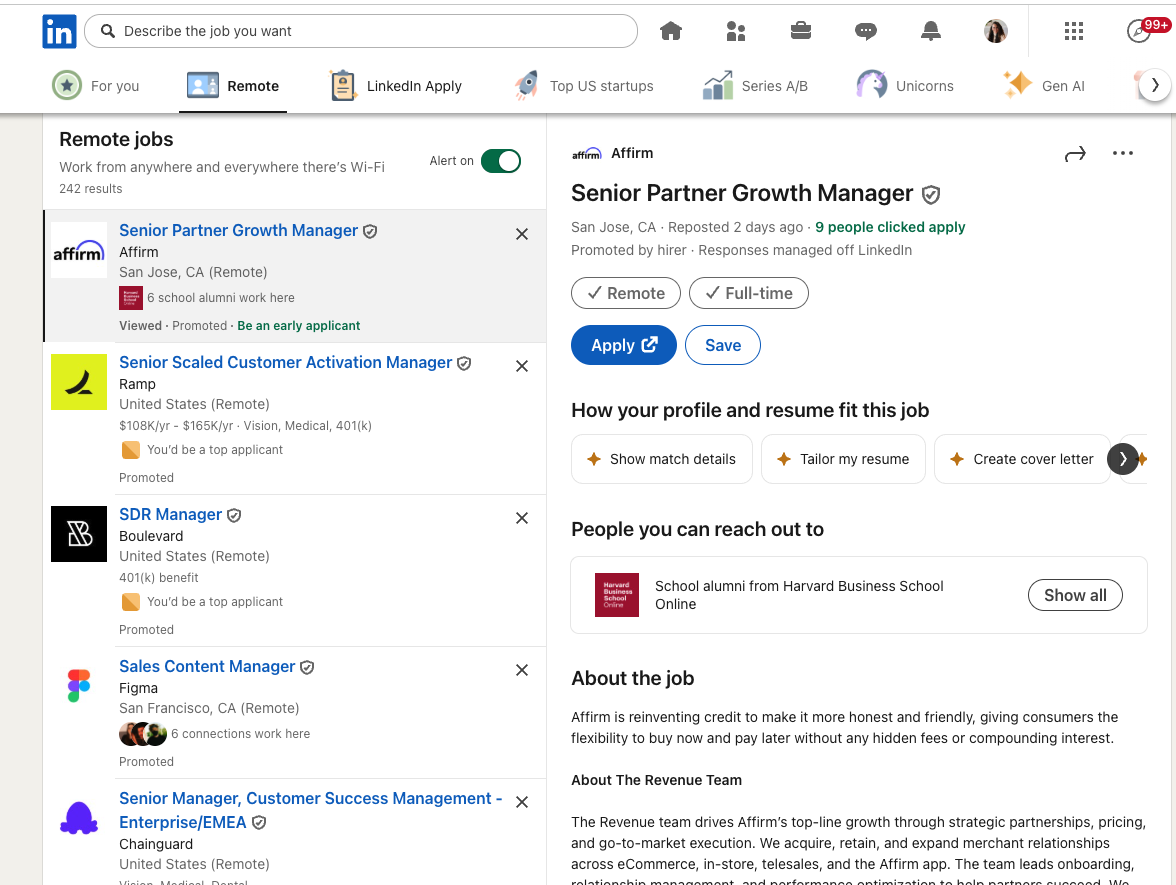
Most career changers I coach in 2026 are still searching for remote CSM jobs the way they did in 2022. They filter for "remote," ignore the fine print, apply to 50 roles, and wonder why they get auto-rejected before a human even reads their resume.
The 2026 remote CSM market is not dead, but it is structurally different from the post-2020 era. Companies have published clearer return-to-office policies, posted explicit time zone requirements, and tightened location filters. The candidates who understand these remote roles fast. The ones who do not waste an entire season.
The 2026 remote CSM reality (the data)
A LinkedIn snapshot of US Customer Success Manager postings shows the work-arrangement split as 60.8% on-site, 20.1% hybrid, and 19.1% fully remote. That is a meaningful minority for fully remote roles, but it is no longer the default model.
For context, Robert Half's Q1 2026 broader US labor market data show that only 4% of new postings are fully remote across the economy. Technology postings are slightly more remote-friendly at 8%, but customer support and administrative postings are only 5% remote. CSM-specific roles sit much higher than the cross-industry average, which is the good news. The bad news is that "remote CSM" still describes a real minority of postings, not a majority.
The takeaway: fully remote CSM jobs exist, they are more common than in most other roles, and you have to compete for them deliberately.
Companies still hiring fully remote CSMs in 2026
These are the companies with public evidence from 2026 of remote-first or fully remote CSM hiring. Save this list. Apply here first.
Remote-native SaaS:
GitLab: all roles remote, with country and location eligibility requirements. CSM postings active across regions.
Zapier: remote-first since 2011. Hires Automation Strategists (a CSM-adjacent role) on remote terms with country restrictions.
Automattic: fully remote, open vacation policy. Customer-success-adjacent roles include Happiness Engineer.
Buffer: distributed team across 22 countries, 11 time zones. Transparent salary philosophy.
Close: USA-only, 100% remote. Async culture, explicit time zone preference for ET, CT, MT, and PT.
Atlassian: Team Anywhere policy. Most employees can work from any approved location, with no required office days.
Customer success software vendors (a natural fit because they sell to CS teams):
Gainsight: senior and principal CSM postings explicitly remote, US-based. A recent principal posting showed $155K to $165K.
ChurnZero: officially remote-first with generous work-from-home options.
Vitally: remote-first, with employees in the US and London.
Global HR or EOR platforms (they specialize in distributed work, so they hire that way too):
Deel: global, fully remote. Recent CSM postings worldwide.
Remote.com: candidates can demonstrate impact from anywhere. Customer experience and success roles remote.
Employee-choice models:
HubSpot: 72% of employees chose @home in 2025. Customer Success roles available remotely. Note: you must work from the legal entity where you were hired.
Companies that have moved CSMs back to hybrid or onsite
If you need fully remote, avoid (or expect office days at) these companies in 2026:
Salesforce: "office-flexible" for many CSM roles, minimum three days in the office per week
Intercom: hybrid policy, three days per week in the office
Notion: anchor days Monday, Tuesday, and Thursday in the office
monday.com: three days a week in the office for most teams
Asana: standard in-office days Monday, Tuesday, Thursday
Datadog: explicitly hybrid workplace, city-based roles
Adobe: 2 to 3 days in the office for office-assigned employees, customer-experience roles skew office-city based
This is not a complete list, and policies shift quarterly. Always read the posting carefully. A role labeled "remote" with an office address in the fine print is functionally hybrid.
How remote CSM pay actually works in 2026
There is no universal "remote discount" in 2026. Companies use one of four pay models, and each one produces a different outcome for your offer.
Model 1: Location-based (cost of labor)
You are paid based on where you live, not what the company would pay in SF or NY. GitLab is the cleanest example. They use US geographic zones, plus country-wide ranges for non-US countries. Drata and Toast use US-only geographic tiers (Zone A, Zone B, Zone C).
What this means for you: if you move from SF to Boise, your salary drops. If you negotiate from a higher cost-of-labor city, you anchor higher.
[SCREENSHOT 7 GOES HERE: GitLab compensation handbook screenshot showing US geographic zones]
Model 2: Anchor city (one US benchmark)
The company pays the same regardless of where you live in the US, anchored to one expensive metro. HubSpot anchors to New York City. A domestic move from New York to Illinois does not change your salary.
What this means for you: this is the best deal for candidates in lower-cost US cities. Same paycheck, less rent.
[SCREENSHOT 8 GOES HERE: HubSpot compensation philosophy screenshot showing NYC anchor]
Model 3: Global ranges (location agnostic)
The company pays one global range and prioritizes internal equity over location. Automattic is the clearest example. Buffer publishes its formula publicly.
What this means for you: rare model, often pays slightly lower at the top but higher at the bottom than location-based models.
[SCREENSHOT 9 GOES HERE: Automattic compensation page screenshot showing global ranges]
Model 4: Mixed or undefined
Many SaaS companies have not published a clear policy. The salary band in the posting is the only information you get. This is the most common model in the mid-market.
What this means for you: ask the recruiter in your first call which model the company uses. Their answer tells you how to negotiate.
ZipRecruiter reported a remote CSM average of $83,064 in mid-2025, with top earners around $120K. Built In reported a remote Client Success Manager average base of $107,584 and total compensation of $129,120, skewing toward tech-company respondents. The spread is wide because the market is fragmented.
Why most remote CSM applications get rejected in 2026
Remote roles attract 60% of applications while representing only about 20% of postings. That ratio is brutal. Most rejections happen for structural reasons before your resume gets read.
The 7 most common rejection patterns:
Location or work authorization mismatch: You applied from the wrong state, country, or time zone. Auto-rejected by ATS knockout questions.
Generic "anywhere" applications: you said you want remote but did not show why this specific company, product, segment, or CS motion fits.
Weak quantified impact: your resume lists accounts and tools, but no retention, churn, expansion, or adoption numbers. "Managed 25 accounts" reads as activity. "Reduced churn risk across a $4M book by 23%" reads as impact.
Missing remote-readiness signals: no evidence of async work, distributed teamwork, written documentation, or self-management.
Tool keyword gaps: your resume omits Gainsight, Salesforce, Gong, Slack, or other exact systems the posting names.
No revenue ownership or domain depth: pure relationship or support experience without renewals, upsell, or specific industry expertise.
AI-generated applications: Close explicitly states "obviously AI-generated applications will be disregarded." Recruiters can tell.
Frequently asked questions
Are remote Customer Success Manager jobs still available in 2026?
Yes, but they are a minority of the market. Roughly 19% of CSM postings on LinkedIn are fully remote, 20% are hybrid, and 61% are on-site. Fully remote roles cluster at remote-native SaaS companies, CS software vendors, and global HR or EOR platforms.
Which companies still hire fully remote CSMs in 2026?
GitLab, Zapier, Automattic, Buffer, Close, Atlassian, Gainsight, ChurnZero, Vitally, Deel, Remote.com, and HubSpot (employee-choice model) all have current evidence of hiring for remote-first or fully remote CSM roles.
Does remote pay less than in-office in 2026?
It depends on the company's pay model. Location-based companies (GitLab, Drata, Toast) pay you based on where you live. Anchor-city companies (HubSpot) pay the same regardless of US location. Global-range companies (Automattic) ignore location entirely. Ask the recruiter which model applies before you negotiate.
Do I need to be in a specific US time zone for remote CSM jobs?
Often yes. Most US remote CSM postings require alignment with a customer territory time zone, such as Pacific, Central, or Eastern. Examples include Close (preference for ET, CT, MT, PT), Glean (Central required), Toast (Pacific or Mountain), and Jasper (Eastern required).
Can I get a remote CSM job at a US company if I live outside the US?
Only at companies with global hiring infrastructure (Automattic, GitLab, Deel, Remote.com, HubSpot, Camunda). Most US SaaS cannot hire internationally without an EOR or local entity.
What's the biggest mistake remote CSM applicants make in 2026?
Applying to roles where they do not meet the location or time zone requirement, then blaming the market when they get auto-rejected. Read the posting fine print every time.
Closing
Remote Customer Success Manager jobs in 2026 are not the open frontier they were in 2022. They are a smaller, more competitive, and more structured market. Candidates who understand the rules (location, time zone, pay model, skills, and tools) land remote roles quickly. The ones who do not waste an entire season applying to roles they cannot hold.
The market is not the enemy. Misreading it is.
P.S. New here? I'm Gozde, a Customer Success Manager based in San Francisco. I coach career changers into their first remote CSM role at SaaS companies, typically in 8 to 16 weeks. If you are stuck on which companies to target or how to position for remote readiness, book a 1:1, and we will map your search together.