
Customer Success Manager Salary in 2026: The Real Numbers
The Customer Success Manager Salary Spread Nobody Explains
The same role pays $59,000 to one person and $180,000 to another. That is not a typo. That is the customer success manager salary spread in 2026, and most career changers are quoting the wrong half of it.
The thesis: your customer success manager's salary in 2026 is not set by the market. It is set by which segment you target, where you work, and whether you walk into the negotiation knowing the real numbers.
TL;DR
The 2026 customer success manager salary in the US runs roughly $70k to $140k base, depending on segment and seniority.
Job-posting data puts the national median CSM base near $130k, with San Francisco around $150k.
A CSM (customer success manager, the person who owns retention and growth for existing accounts) in SaaS earns more than the same title in non-tech, often by 30k or more.
Total comp matters more than base. Strong SaaS CSMs hit $150k to $200k OTE once bonus and equity are counted.
Why this matters
Most people breaking into customer success anchor to the lowest number they find. They see $59k on one site and assume that is the ceiling. It is the floor.
Negotiate from the wrong benchmark and you can leave $30k to $50k on the table in a single offer. Over five years, that is a house down payment.The 2026 remote CSM reality (the data)
What is the average customer success manager salary in 2026?
The honest answer: it depends on the dataset, but a solid working national benchmark is $90k to $130k base for a standard CSM, with strong SaaS roles pushing $140k.
The ranges look wide because each source defines "CSM" and seniority differently:
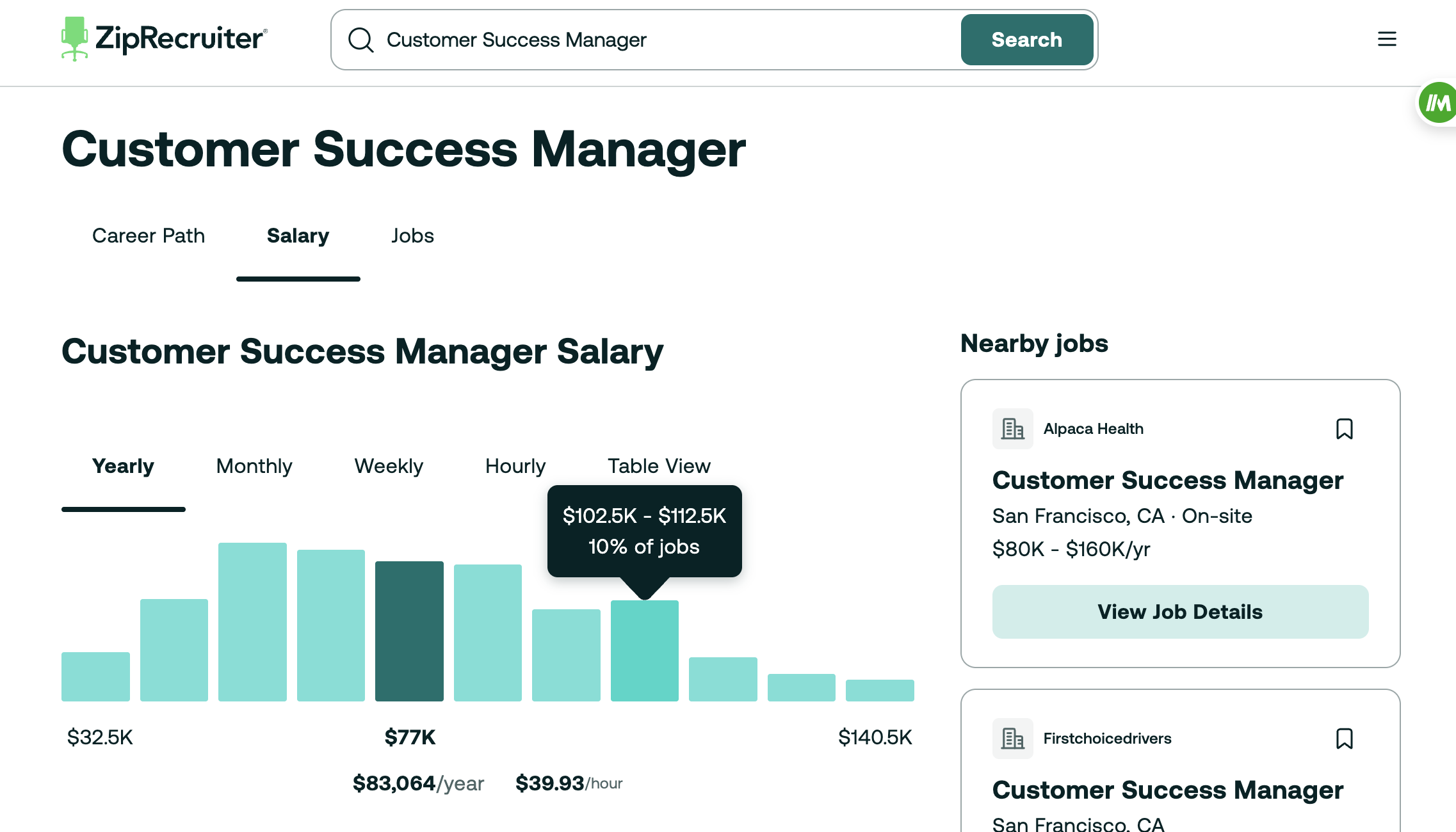
ZipRecruiter: average about $83k, most roles between $59k and $99k, top around $120k.
Indeed: average base about $92.6k, with a typical range from roughly $54.6k to $157k.
Robert Half (skews SMB and non-SaaS): typical band $67k to $89k.
Salary.com (skews established corporate): average $127.6k, most between $109k and $149k.
Customer Success Collective (global view): 2026 median baseline of $70.5k before bonus or stock.
A clean way to read this:
Early or mid-level CSM outside FAANG and unicorn SaaS: roughly $70k to $110k base.
Strong mid-level or senior CSM in SaaS or larger tech: roughly $100k to $140k base, with OTE higher once variable pay is added.
OTE means on-target earnings, your base salary plus the bonus or commission you earn if you hit your number.
Why do CSM salary ranges look so different?
Because "customer success manager" isn't a single job. It is a title stretched across very different companies.
The biggest swing factors:
Industry. SaaS and tech pay a premium. Non-tech and SMB pay less for the same title.
Seniority. A "CSM" running a $5M book of strategic accounts is paid like a senior IC, not an entry hire.
Location. Tech hubs pay 15% or more above fully remote roles.
Comp structure. Some roles load base. Others load variable. Two $120k OTE offers can have very different base salaries.
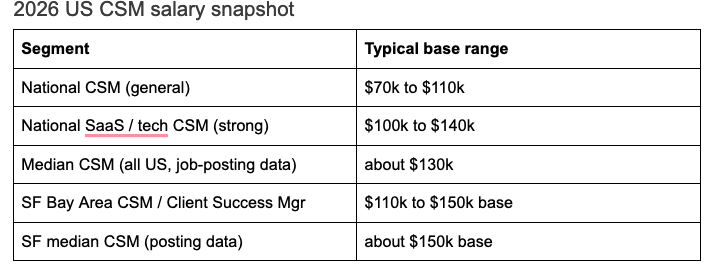
This is why the snapshot table below is more useful than any single average.
What does a customer success manager make in San Francisco?
In San Francisco, expect $110k to $150k base for a mid-level CSM, with total comp commonly landing $125k to $180k once variable pay is included.
The tech-hub data is consistent:
Recruiting From Scratch (1,000 2026 postings): national median $130k, SF median $150k, about 15% above remote roles.
Built In SF (2026): average base $111.7k, average additional cash $34.5k, average total comp about $146.3k.
Indeed SF: average around $131k, with some postings above $180k.
So an SF SaaS CSM total comp band in 2026 looks like this:
Solid mid-level IC: about $110k to $140k base, plus 10% to 30% variable, so $125k to $180k OTE.
Senior or strategic CSM: about $130k to $160k base, with OTE reaching $150k to $200k at top payers.
Is customer success a good career in 2026?
Yes. Customer success now sits on the revenue side of the business, not the cost side, and that shift is what keeps pay climbing.
When I broke into this field, my first CS-adjacent role paid in the high $60,000s. A decade of owning retention and expansion later, the same career puts senior CSMs in SF near $200k base before equity. That trajectory is the actual product. Not the first offer. The slope.
The reason is simple. Net revenue retention, the percentage of recurring revenue you keep and grow from existing customers, is now the metric boards obsess over. The person who protects and grows that number is paid accordingly.
How do you reach the top of the CSM salary band?
You target the right segment, and you prove you move retention and expansion numbers, not just "manage relationships."
Three levers move you up the band fastest:
Segment up. Move from SMB accounts toward mid-market and enterprise, where books of business are bigger and comp follows.
Speak in metrics. Tie your work to NRR (net revenue retention), GRR (gross revenue retention, the revenue you keep before any expansion), and renewal rates.
Own a number. The CSMs who command $140k+ can point to specific churn they stopped and expansion they drove.
Stop applying as a "people person who loves helping customers." Start applying as the person who protects recurring revenue.
What to do this week
Pull three real CSM job postings in your target city and write down the actual posted base ranges. Anchor to those, not to averages.
Pick your segment. Decide whether you are targeting SMB, mid-market, or enterprise CSM roles, as the pay and pitch differ.
Rewrite one resume bullet to include a retention or revenue number from your past work, even from a non-CS job.
Set your floor. Based on the segment table above, write down the base number you will not go below.
Frequently asked questions
What is the entry-level customer success manager salary in 2026?
Entry-level CSM roles outside major tech hubs typically pay $60k to $85k base. In SaaS or in cities like San Francisco, even early-career CSM roles often start at $90k-$110k base, especially when the company loads variable pay on top.
Do customer success managers earn commission or a bonus?
Most do. CSM comp usually includes a variable component of 10% to 30% of base, tied to renewals, retention, or expansion. That is why OTE, your base plus on-target variable pay, is a better comparison number than base salary alone when weighing offers.
Is customer success a good career for career changers in 2026?
Yes. Customer success rewards transferable skills such as relationship management, problem-solving, and communication, which career changers from sales, teaching, hospitality, and support already possess. The salary trajectory is strong, and the field is still hiring people without a prior CSM title.
How much does a senior customer success manager make in San Francisco?
Senior or strategic CSMs in San Francisco commonly earn a $130k to $160k base salary in 2026, with total comp reaching $150k to $200k once bonuses and equity are included. Top payers and enterprise-focused roles can push above that range.
Why is the customer success manager's salary range so wide?
Because the title covers very different jobs. Industry, seniority, location, and comp structure all swing the number. A non-tech SMB CSM and an enterprise SaaS CSM in SF share a title but can be $70k apart in base pay.
Negotiate from the floor, not below it
The market is not deciding your customer success manager's salary. Your benchmark is. Walk in, quoting the $130k median and SF numbers near $150k, and you start from the floor instead of under it.
P.S. New here? I am Gozde Gorce, a post-sales leader with 10+ years scaling customer success at hyper-growth SaaS startups, now coaching career changers into CS through my course How to Break Into Customer Success. Connect with me on LinkedIn and grab the course at https://www.gozdegorce.com/break-in.