
What Does a Customer Success Manager Actually Do?

What Does a CSM Do? A Plain-English Breakdown for Career Changers
Most people think a Customer Success Manager is a fancy name for support. They are wrong, and that misunderstanding is exactly why so many qualified career changers never apply.
Here is the thesis: a CSM is not the person who fixes the ticket. A CSM is the person who makes sure the customer never wants to leave, and quietly grows the account while doing it.
TL;DR
What does a customer success manager do? A CSM owns the relationship with existing customers after the sale, driving retention, renewals, and account growth.
A CSM is not support and not sales. They sit in the middle, focused on the customer getting real value from the product.
The daily work is part relationship, part strategy, part problem-solving: onboarding new accounts, running check-ins, watching account health, and renewing contracts.
You do not need a tech or coding background to do this job. You need the skills you have probably already been using for years.
Why this matters
If you are eyeing a career change into tech, Customer Success is one of the most accessible high-paying entry points there is.
But you cannot land a role you cannot describe. Hiring managers can tell within two minutes whether you understand the job or just read the title.
Understand what a CSM actually does, and you stop sounding like an outsider applying for a buzzword. You start sounding like someone who already gets it.
What does a customer success manager do?
A CSM owns the customer relationship after the deal closes. Their job is to make sure customers get value, stay subscribed, and spend more over time.
Customer Success is the function inside a software company responsible for keeping existing customers happy, renewing, and growing. The CSM is the human who owns that relationship.
Sales wins the customer. The CSM keeps the customer. In a subscription business, keeping them is where the real money lives, because it costs far more to win a new customer than to retain one you already have.
What does a CSM do all day?
The day-to-day is a mix of relationship work, strategy, and quiet firefighting. No two days look identical, but the work falls into a handful of buckets.
Here is what a typical week includes:
Onboarding new accounts. Onboarding is the first 30 to 90 days where you get a new customer set up and seeing value fast. Slow onboarding is the number one predictor of churn.
Running check-ins and QBRs. A QBR (Quarterly Business Review) is a scheduled meeting where you show the customer the results they are getting and plan the next quarter.
Watching account health. A health score is a simple red, yellow, or green signal that tells you which accounts are thriving and which are about to leave.
Owning renewals and expansion. When the contract is up, the CSM makes sure it renews, and looks for chances to expand the account into more seats or products.
Being the customer's voice internally. When a customer needs something from product or engineering, the CSM is the one who carries that message and pushes for it.
The thread connecting all of it: churn. Churn is when a customer cancels. The entire CSM role exists to prevent it and to grow the accounts that stay.
How is a CSM different from support and sales?
Quick version: support is reactive and ticket-based, sales closes new deals, and the CSM owns the ongoing relationship and the renewal. Here is the clean comparison.
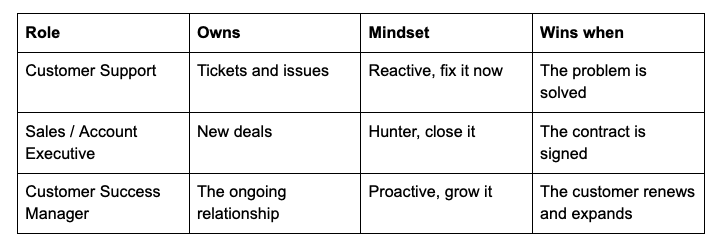
The big shift is proactive versus reactive. Support waits for the customer to raise a hand. The CSM reaches out before anything breaks.
What skills does a CSM actually need?
The core skills are communication, relationship-building, problem-solving, and comfort with data. Notice what is missing: coding.
Most of these you have already used in another job:
Managing relationships under pressure (teaching, hospitality, healthcare, account management)
Explaining complicated things simply (any client-facing or training role)
Spotting a problem before it explodes (operations, project management)
Reading the numbers to make a case (anything with a target or a budget)
This is the part career changers miss. The hardest skills in Customer Success are human skills, and you do not learn those in a bootcamp. You bring them with you.
What to do this week
If Customer Success sounds like the job for you, do not wait until you feel "ready." Start now.
Write down your three strongest relationship wins from your current job. These become your interview stories.
Follow 5 CSMs on LinkedIn and read how they describe their work. Learn the language.
Map one past responsibility to a CSM task using the buckets above. Find your bridge.
Look up 3 entry-level CSM job posts and highlight every requirement you already meet. You will meet more than you think.
FAQ
What does a customer success manager do in simple terms?
A customer success manager ensures existing customers derive value from the product, remain subscribed, and increase their spend over time. They own the relationship after the sale, handling onboarding, regular check-ins, and renewals. The goal is simple: keep customers happy so they do not leave.
Is a CSM a sales job?
Not exactly. A CSM is responsible for renewals and account growth, so revenue is part of the role, but they are not cold-calling or closing new logos. The focus is on keeping and growing customers who have already bought, through relationship and value, not the hard sell.
Do you need a tech background to be a CSM?
No. Customer Success is a relationship and problem-solving role, not a coding role. You need to communicate clearly, manage clients, and solve problems. The software and tool knowledge is learnable on the job, which is why so many career changers from non-tech fields succeed in it.
What is the difference between a CSM and customer support?
Customer support is reactive and handles tickets and issues as they come in. A CSM is proactive and owns the long-term relationship, reaching out before problems happen and focusing on renewals and growth. Support solves the moment. The CSM protects the whole account.
How do I become a CSM with no experience?
You translate the experience you already have. Map your past relationship, communication, and problem-solving wins to CSM tasks, learn the core SaaS vocabulary, and target the right roles instead of mass-applying. Most career changers can make the switch in 3 to 6 months with the right system.
P.S. New here? I am Gozde Gorce, a post-sales leader with 10+ years scaling customer success at hyper-growth SaaS startups, now coaching career changers into CS through my course How to Break Into Customer Success. Connect with me on LinkedIn and grab the course at https://www.gozdegorce.com/break-in.