
CSM vs. Account Executive: Which Role Actually Suits You?

CSM vs account executive: mission, comp structure (OTE explained), pressure, and career paths compared, plus which backgrounds map to each role.
TL;DR
A CSM (Customer Success Manager) keeps and grows existing customers; an account executive (AE) closes new ones.
In the csm vs account executive comp question, AEs carry bigger variable upside and bigger swings; CSMs earn a more stable base.
Closers and hunters thrive in AE seats. Teachers, support pros, and service backgrounds usually map to CS.
Why this matters
Career changers burn months applying to both roles at once with one generic story.
Hiring managers can smell the indecision in the first interview.
Pick the lane that fits your wiring, then build the story for that lane.
In this post:
What is the difference between a CSM and an account executive?
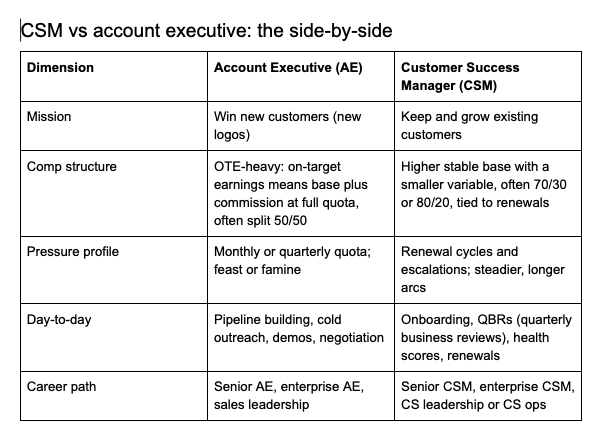
An AE wins new customers; a CSM keeps and grows existing ones. The Customer Success Manager owns everything after the contract is signed: onboarding (getting the customer live), retention (keeping them subscribed), and expansion (growing the account).
The AE owns everything before the signature: finding prospects, running discovery calls and demos, negotiating, and closing.
One sells the promise. The other makes the promise come true. Companies need both, but the daily lives barely overlap.
Don't confuse the AE with an account manager either; that's a third role, and I compare it to CS in my customer success vs account management guide.
Who earns more, a CSM or an AE?
Top AEs out-earn top CSMs, and bottom AEs earn less than almost everyone. That's the honest answer.
AE compensation is built on variable upside: crush quota and the commission multiplies, miss it and your take-home drops hard. CSM pay leans on a stable base with a modest variable, and 2026 CSM salary data shows solid bases with steady growth.
Here's what I tell my clients: don't compare the ceilings, compare the floors. If a zero-commission month would wreck your budget or your sleep, the AE ceiling isn't worth the AE floor.
Which role fits your background?
Map your wiring, not your resume keywords:
Closers and hunters who love the chase, handle rejection well, and want commission upside: AE.
Teachers who build long relationships and love watching people improve: CS, and teachers have a proven path.
Support and service backgrounds who already de-escalate and problem-solve daily: CS, starting with my customer service to customer success guide.
Salespeople who are tired of the hunt but love customer conversations: CS is a real option, and my sales to customer success post covers that pivot properly.
Still torn? Run the is customer success right for me decision framework before you build a single resume.
What to do this week
Write down your three best work moments ever. If they're wins and closes, look at AE. If they're rescues and long-game payoffs, look at CS.
Interview one AE and one CSM (15 minutes each) and ask what a bad week looks like. The bad weeks decide this, not the good ones.
Once you pick CS, start with my guide to becoming a CSM with no experience and commit to one story.
FAQ
Can a CSM become an account executive later, or the reverse?
Yes, both directions happen regularly. CSM-to-AE works when you've run expansion revenue and want more upside. AE-to-CSM works when your discovery and relationship skills outweigh your love of prospecting. Companies like hiring across the aisle because each side knows what the other promises customers.
Is a CSM role a sales job?
Partly, and pretending otherwise hurts candidates. Most CSM roles carry renewal targets and expansion goals, which are commercial responsibilities. The difference is posture: CSMs grow trust over years instead of chasing strangers. If "sales without cold calls" sounds appealing, CS will fit better than you expect.
Do AEs or CSMs have better job security?
CSMs, modestly. Retention teams protect existing revenue, which boards guard hardest in downturns, while sales teams get resized when pipelines shrink. No role is layoff-proof. An AE with a strong track record and a CSM with strong save stories are both hard to cut.
Which role is easier for career changers with no tech experience?
CS, in most cases. AE roles usually demand demonstrated quota history, while CS hiring managers accept translated experience plus proof artifacts from teaching, support, retail, and healthcare backgrounds. I've coached 200+ career changers, and the CS door opens more often.
What does OTE actually mean in a job posting?
OTE stands for on-target earnings: your base salary plus the variable you'd earn at 100 percent of quota. An AE posting of "$140K OTE" might mean $70K base. Always ask for the split, the quota attainment rate on the team, and what the average rep earned last year.
Two doors, one decision: chase the win or grow the relationship. Pick the pressure you can live with for five years, not five months.
Want one career-clarity play like this every week? Join my newsletter, the signup box is right on this page, and it's where I answer reader questions like this one first.
When you're ready, here's how I can help you land a job in Customer Success despite all the competition:
How to Break Into Customer Success (The Course) - The full system: 12+ hours of on-demand video, mock interviews with tech leaders, workshops, and 10+ templates to land your first CS role. $396 one-time or 4 x $99.
How to Build Your Customer Success Resume - The 5-Part CSM Resume Framework with real before/after bullet rewrites, so your resume gets noticed and starts bringing in interviews.
CSM Interview Prep & Company Scanner GPT - Plug in the company, job post, and your resume. Get tailored briefings, likely interview questions, and mock practice with feedback.
Translate Your Past Work Experience Into Customer Success - A 21-minute workshop and CAR worksheet that turn your old industry into CS-ready resume bullets and interview answers.
1:1 Private Session - Personalized support for mock interviews, case study prep, or offer negotiation.
Connect with Gozde:
Email me at info@gozdegorce.com
P.S. New here? I'm Gozde Gorce, a post-sales leader with 10+ years scaling Customer Success at hyper-growth SaaS startups, now coaching career changers into CS. Connect with me on LinkedIn.